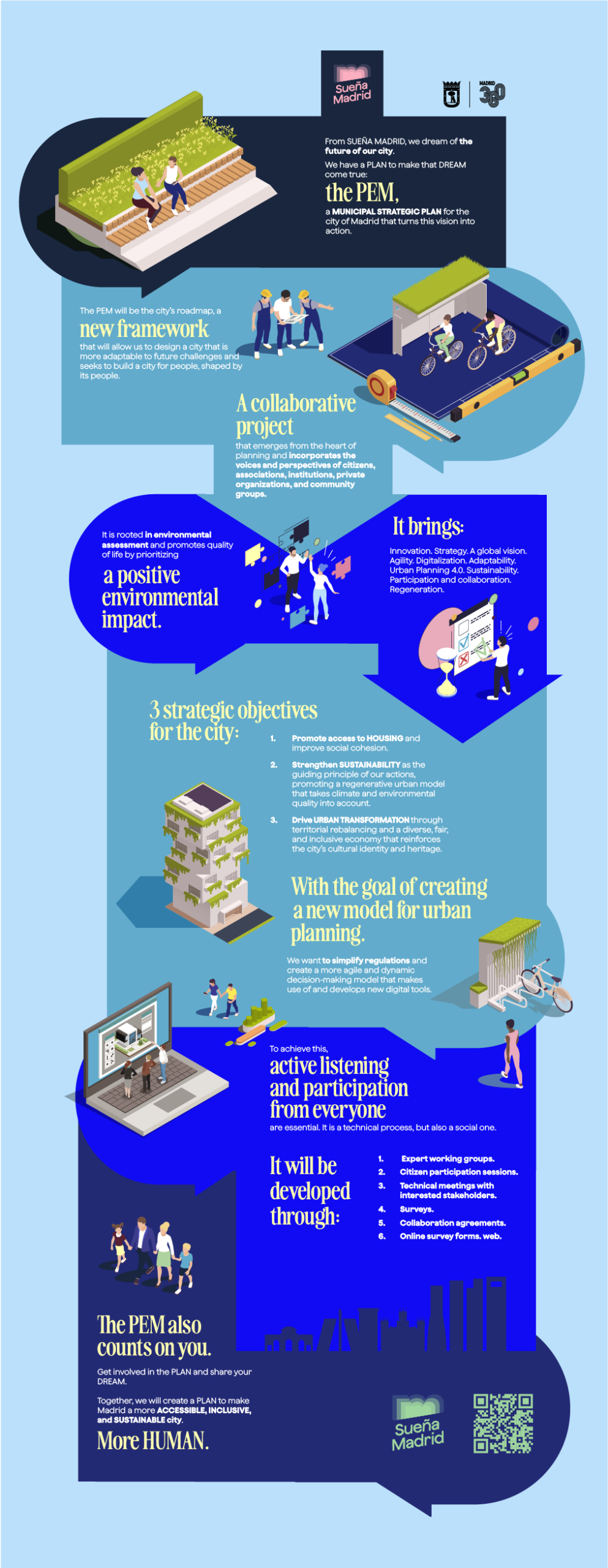
We are designing a new roadmap for Madrid. The Municipal Strategic Plan (PEM) will make it possible to shape the city with greater adaptability to future challenges, building a city for people, from people.
The approval of Regional Law 7/2024 by the Community of Madrid, which amends Law 9/1995, introduces Municipal Strategic Plans, a new tool that renews traditional approaches to urban planning.
Article 14.7 of Law 7/2024 states that municipalities may draw up Municipal Strategic Plans as part of the development of territorial planning instruments.
Article 18 establishes that Municipal Strategic Plans define the basic elements for the organisation and structure of the municipal area, its strategic objectives and the reference framework for all other urban planning instruments in the municipality. The same article also regulates the purpose, content and approval process for these plans.
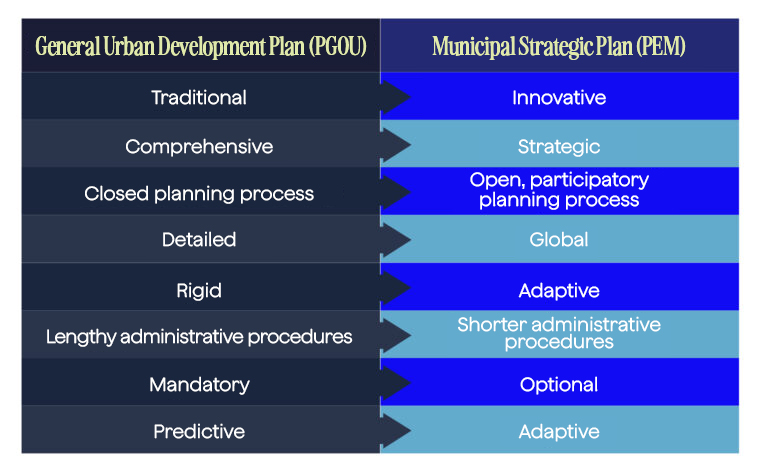
PGOU vs PEM: differences between the General Urban Development Plan and the Municipal Strategic Plan
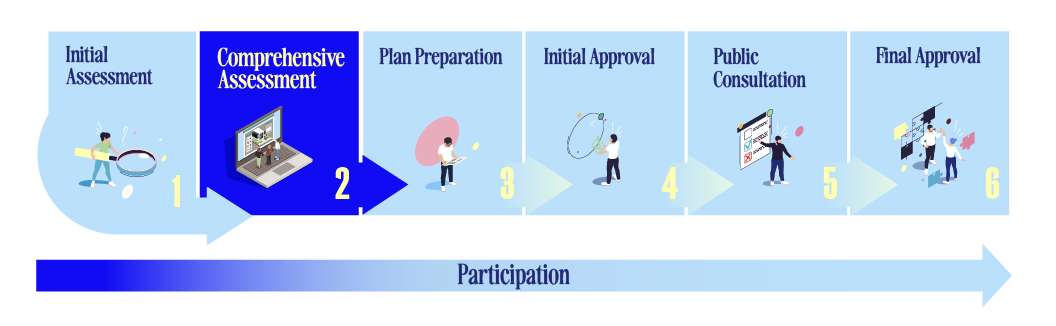
Phases in the development of the Municipal Strategic Plan
What stage is the PEM at?
In 2024, we launched a process of listening and participatory reflection, working with society as a whole to develop a new planning instrument — Madrid’s Municipal Strategic Plan (PEM) — designed to guide the city into the future.
As a result of this process, on 19 December 2025 we began the administrative procedure before the Community of Madrid, taking a decisive step towards shaping the city’s urban future by presenting two key documents for the development of the PEM: the Initial Strategic Document (DIE) and the BASE Document (Open Draft of the Strategic Summary).
Principles and Nature of the PEM
Metropolitan Vision
Recognizes Madrid as part of a complex metropolitan area, where planning cannot be isolated from neighboring municipalities.
Multidisciplinary Intelligence
It is based on the collective collaboration of multidisciplinary teams, cooperation with various bodies and institutions, and public participation. It views urban planning as a broad concept that encompasses relationships, mobility, and health—not just territory.
Adaptive "Urban Charter"
Rather than a rigid, detailed plan, the PEM is conceived as an “urban charter” that sets clear objectives and strategic directions, while allowing multiple pathways to achieve them.
Balanced Approach
The key lies in achieving balance across all sectors (housing, sustainability, economy, etc.). It analyzes existing conditions to determine where and to what extent growth can occur, prioritizing harmonious development.
Performance-Based and Participatory
Performance-based because it sets very clear objectives without strictly dictating how to meet them, allowing for multiple ways to achieve compliance. Participatory because it engages sector-specific bodies from the initial consultation stages, integrating their needs. It is a draft open to both public and professional participation.
Regulatory Hierarchy
The PEM is an innovative, legally binding framework that holds hierarchical superiority over the 1997 General Plan. This enables it to overcome the rigidity of the previous plan and act as a catalyst to transfer content that is not essential to its core planning purpose into other regulatory instruments.