Sueña Madrid. Plan Estratégico Municipal

Mesa Cultura y patrimonio

Working Group 7

Culture and Heritage

Madrid as a truly global hub for original culture, one that should avoid imitation in order to establish itself as an inspiring and creative city on the world stage. 

The Culture and Heritage Working Group began from a fundamental premise: cities are not only physical infrastructures, but also cultural constructions that reflect the values, aspirations, and moods of society at each moment in history. In this sense, the new Strategic Plan is seen as an opportunity to reconnect the city’s physical dimension with its social and cultural infrastructure, recognising the interdependence between the two. 

The group put forward a broad, cross-cutting reflection on how to activate cultural ecosystems, rethink the role of architectural heritage, and adapt regulatory frameworks to an increasingly hybrid, digital, and changing creative reality. 

Participants from the public, private, and third sectors
0
Working sessions
0
Working groups
0

Participants

The Culture and Heritage Working Group brought together around 160 participants, organised into four working groups. 

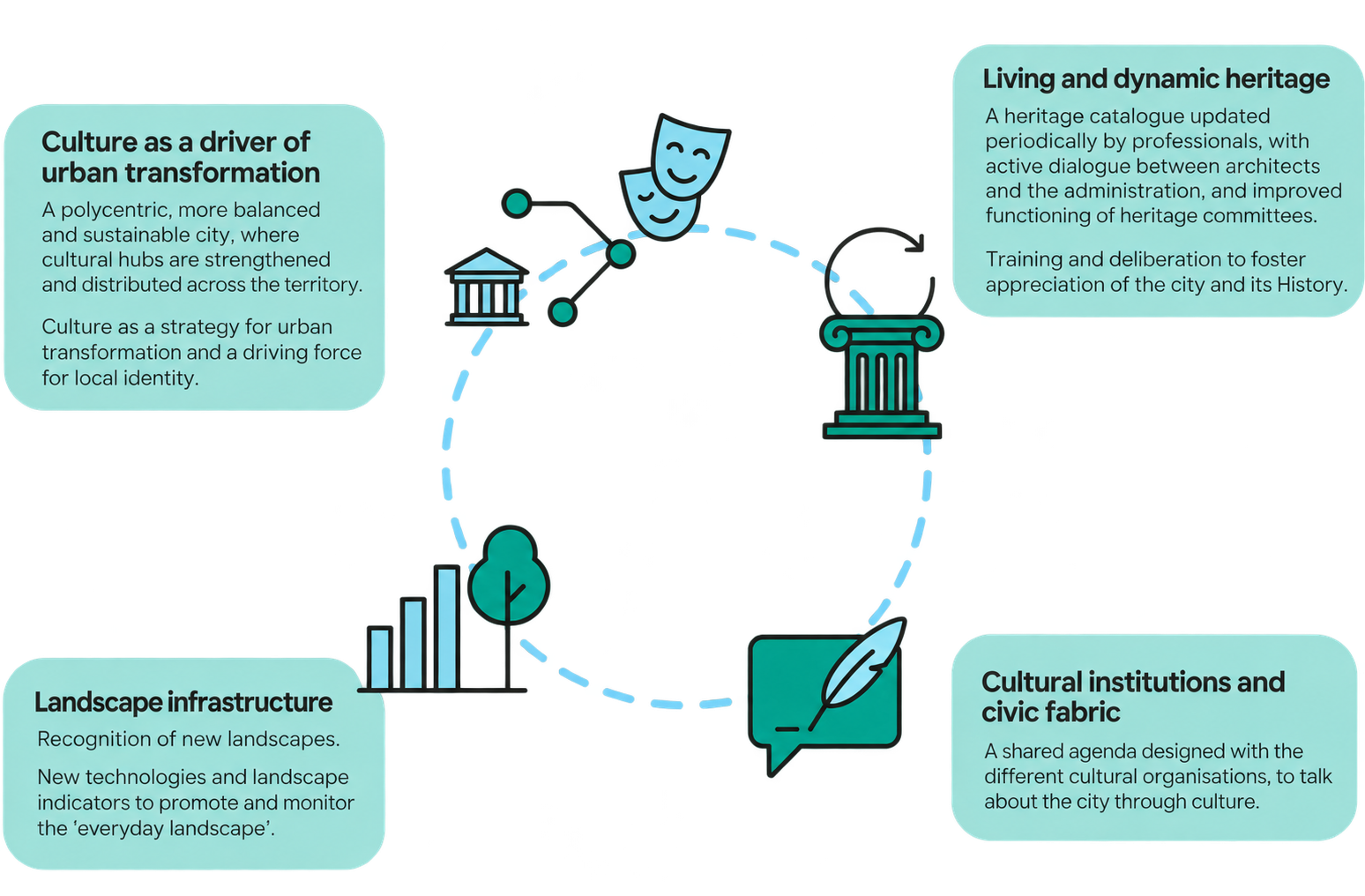
The group on cultural identity and strategy, community fabric, outer neighbourhoods, and emerging practices highlighted the importance of recognising and strengthening grassroots cultural networks in neighbourhoods, valuing local, emerging, and peripheral expressions as key elements of identity, and promoting a polycentric, decentralised culture connected to Madrid’s way of life. 

The group on heritage protection, regulation, and administration addressed the need to update heritage protection tools, catalogues, commissions, and special plans, so that they are more agile, flexible, and effective. It defended a dynamic approach to heritage, one that allows for use and adaptation without losing value, and stressed the importance of education, sensitivity, and careful judgement in the application of regulation. 

The group on landscape and new concepts proposed broadening the understanding of heritage towards a more holistic notion of landscape, including both the exceptional and the everyday. It also suggested creating spatial and temporal indicators that would make it possible to understand and manage landscape as an evolving process, recognising its cultural, environmental, and social value from a cross-cutting perspective. 

The group on cultural institutions proposed creating a shared agenda among cultural institutions to address the city through culture, integrating humanistic thinking into urban planning. 

Academia and universities
0
Public administration
0
Professional associations
0
Companies
0
Independent experts
0
Third sector
0

Working groups 

Cultural identity and strategy, community fabric, outer neighbourhoods, and emerging practices

Heritage protection, regulation, and administration

Landscape and new concepts

Cultural institutions

Ideas discussed 

This working group brought together representatives from institutional, technical, academic, and private-sector backgrounds. Their reflections focused on recognising the city as a living cultural construct, where stories, practices, and social moods shape both the present and the urban future. 

The need to activate cultural ecosystems from a humanistic perspective was addressed, integrating emerging, digital, and peripheral expressions into planning. Participants also proposed rethinking the concept of cultural facilities and promoting open systems and flexible regulations that allow for a more hybrid and decentralised culture.

At the same time, they called for a living architectural heritage — one that can be used and transformed — and for a vision of landscape as a dynamic indicator of urban processes. The group brought together institutions, experts, and cultural actors to collectively build a cultural vision for Madrid that can inspire the new General Plan. 

Related challenges