Driving a new economyfor Madrid, capableofcreatingjobs, attracting and retainingtalent and investment, and adaptingtheterritory and regulatoryframeworksto new productive dynamics, whilestrengtheningthecity’smomentum and competitive advantages.
The Economy, Talent Attraction, and Investment Working Group wascreated as a spaceforreflectiononthechallengeofconsolidating Madrid as a citythatnotonlyattractstalent and investment, butalsooffers a flexible and competitive urbanframeworkcapableofretainingthem. Throughtheregenerationof obsolete urbanfabrics, thediversificationofactivities, and thepromotionof new centralities, thegoalistostrengthenthecity’seconomicstructure, foster a polycentricmodelofdevelopment, and project a distinctiveidentityonthe global stage.
Participants from the public, private, and third sectors
0
Working sessions
0
Working groups
0
Participants
The Economy, Talent Attraction, and Investment Working Group broughttogether more than 198 participants, organisedintofourworkinggroups. The firstfocusedonthehybridisation and mixof uses. The secondaddressedtheflexibilisation and mixof uses. The thirdanalysedthe territorial location and specialisationofactivitiestostrengthencompetitiveness and metropolitan balance. And thefourthfocusedonlanddevelopment and transformationtocreate new centralities and makethebest use ofavailableurbanresources.
Academia and universities
0
Public administration
0
Professional associations
0
Companies
0
Independent experts
0
Third sector
0
Working groups
Hybridisation and mixed uses
Flexibility and simplification of uses
Territorial location and specialisation
Land development and transformation
Ideas discussed
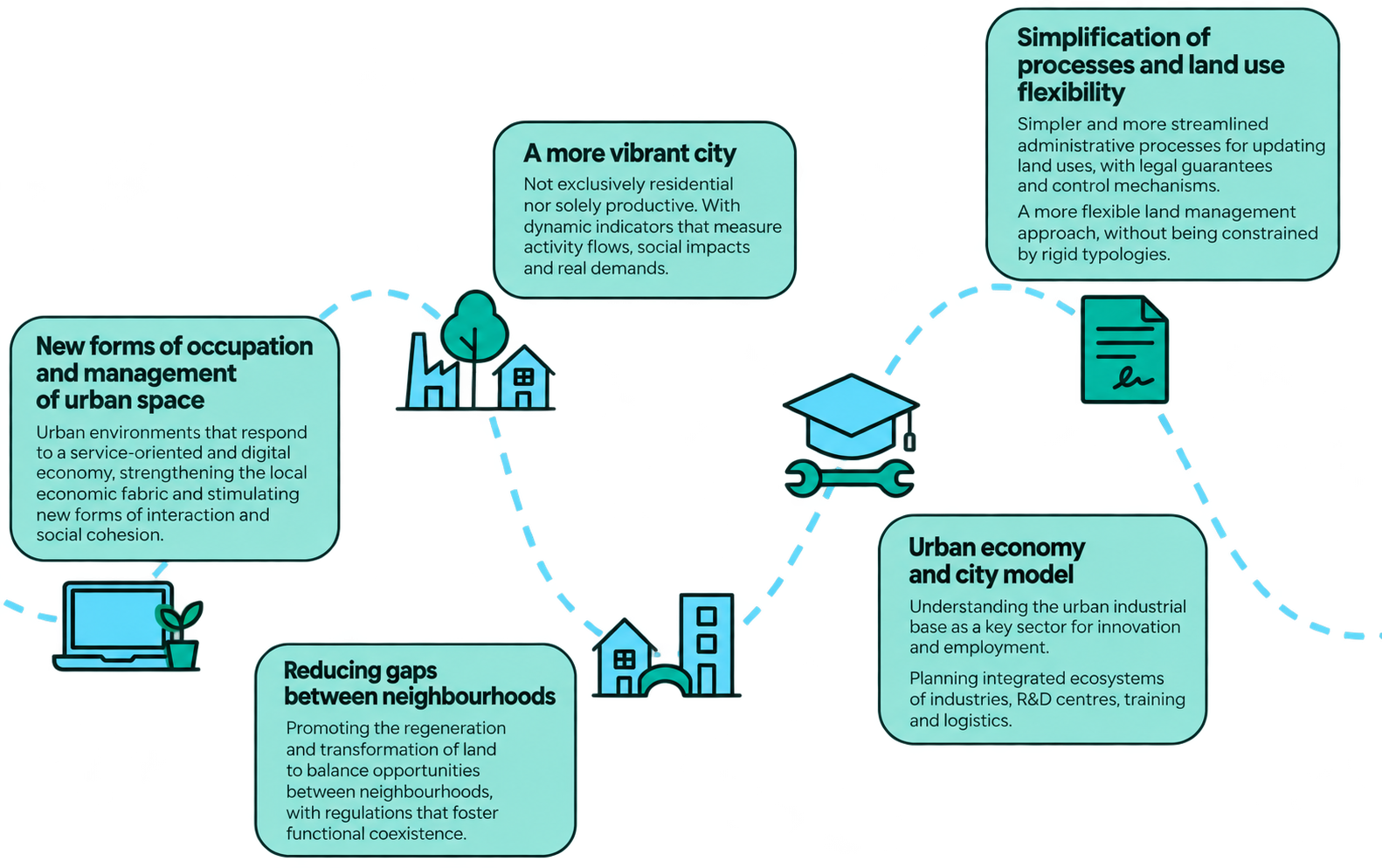
This working group brought together representatives from the institutional, technical, academic, and private sectors. Their reflections focused on the role of the economy as a driver of social cohesion, calling for a broad view of the city in which major corporations coexist with small local businesses.
They also highlighted the role of the economy in balancing opportunities across neighbourhoods, supporting regulations that encourage functional coexistence and reduce inequalities.