Creating a public realm that is vibrant and safe, healthy, high-quality, attractive, diverse, and socially inclusive. Placing public space at the centre of urban life and recognising it as a driver of identity and city transformation, always from a sustainability perspective: a greener and bluer Madrid, healthier, more efficient, and adapted to climate change, with lively neighbourhoods connected to one another and to nature.
The Public Space Working Group starts from the idea of public space as a key element of urban sustainability and climate action. It is essential for delivering mitigation and adaptation measures in response to climate change, but it is also central to health, given the direct relationship between the quality of public space and the reduction of many illnesses, healthier ageing, and, ultimately, quality of life.
The group also focuses on the understanding that streets and squares are both the setting and the catalyst for the relationships that define a city’s way of life and identity, a place for urban coexistence, for intergenerational use by children, young people, and older people alike, and also a place of work, where many people and activities have an economic role.
Participants from the public, private, and third sectors
0
Working sessions
0
Working groups
0
Participants
The Public Space Working Group brought together around 120 participants, organised into four working groups.
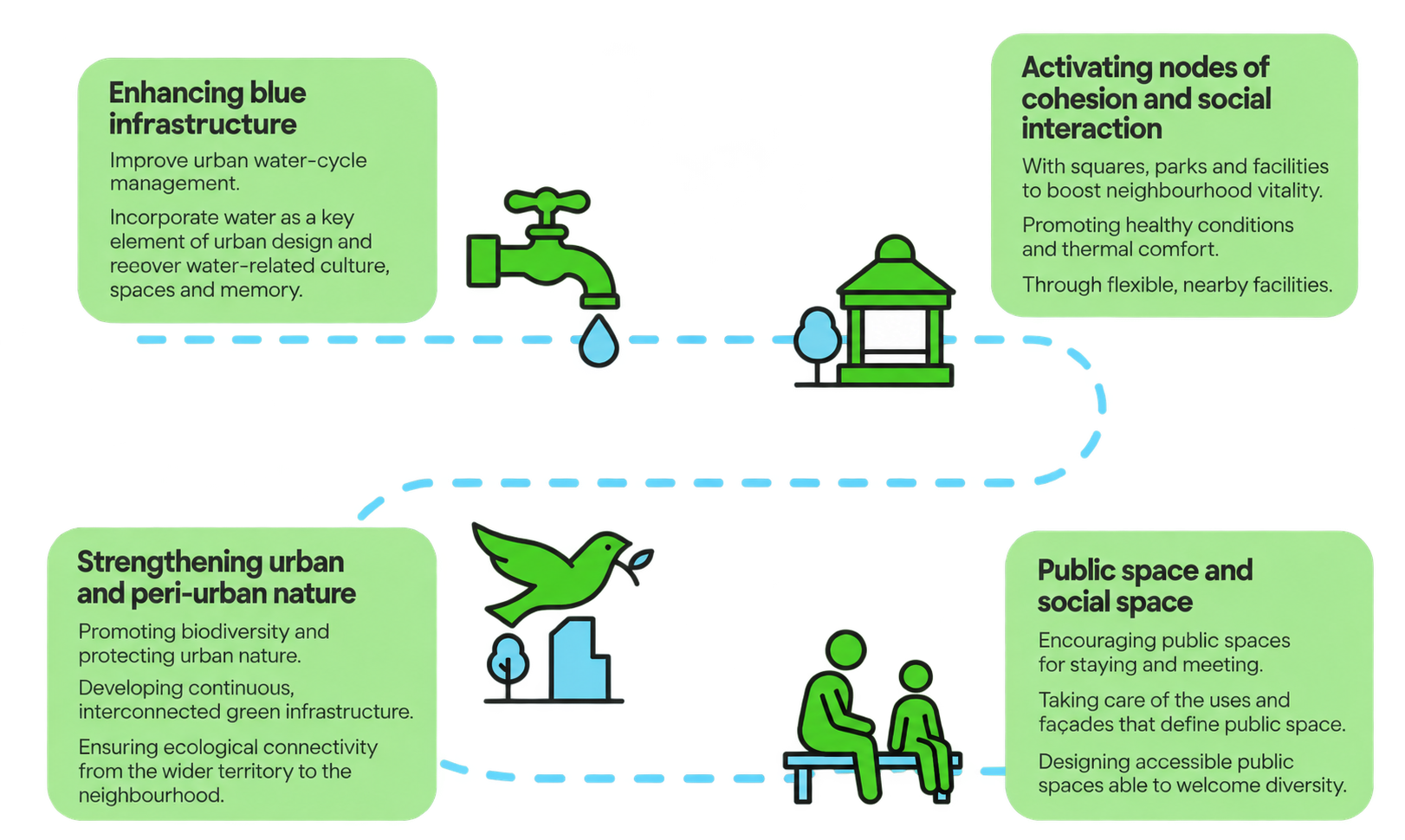
The first focused on urban greening and green infrastructure, with an emphasis on increasing and connecting urban and peri-urban nature at all scales, fostering biodiversity, ensuring ecological connectivity from the territory to the neighbourhood, and recognising the environmental, economic, and health benefits it provides.
The second addressed blue infrastructure, focusing on rethinking the urban model by making water a key driver of design and resilience.
The third analysed the social factors of use that activate nodes of cohesion and social interaction in squares, parks, and facilities, in order to boost vitality and proximity in neighbourhoods.
And thefourthfocusedonurbanidentity and morphology, withanemphasisonpreservingurbanmemory and maintainingneighbourhoodidentity.
Academia and universities
0
Public administration
0
Companies
0
Independent experts
0
Third sector
0
Working groups
Urban greening and green infrastructure
Blue infrastructure
Social factors of use
Urban identity and morphology
Ideas discussed
This working group brought together representatives from institutional, technical, academic, and private-sector backgrounds. Their reflections focused on the need to continue improving the quality of public space through interventions adapted to streets, squares, parks, and gardens, stressing the importance of integrating urban nature to create comfort and liveability, strengthen ecological connectivity, and improve water management as a key element of urban design.
The group also supports the creation of local facilities that generate new centralities in neighbourhoods, while preserving their identity.