PlanningMadrid’s future mobilityfrom a sustainabilityperspective, within a compact, healthy, diverse, and inclusive citymodel, whilemaintainingleadership in sustainablemobility and, at thesame time, exploring new structuringaxes and new mobilitymodelsthatincorporatetechnologyformobilityanalysis, design, and management.
The Sustainable Mobility Working Group was created as a space to rethink how we move around Madrid and how mobility can contribute to a healthier, more efficient, and fairer city. One of the first steps was to reach a shared understanding of what we mean by sustainable mobility, not just as a technical concept, but as a shared vision that connects everyday life with the city’s major urban challenges.
Urban mobility is constantly changing, and any strategy must be able to adapt to new technologies, habits, and challenges. The group therefore aimed not only to find answers for today, but also for the Madrid of the future.
Participants from the public, private, and third sectors
0
Working sessions
0
Working groups
0
Participants
The Sustainable Mobility Working Group brought together around 190 participants, organised into three working groups.
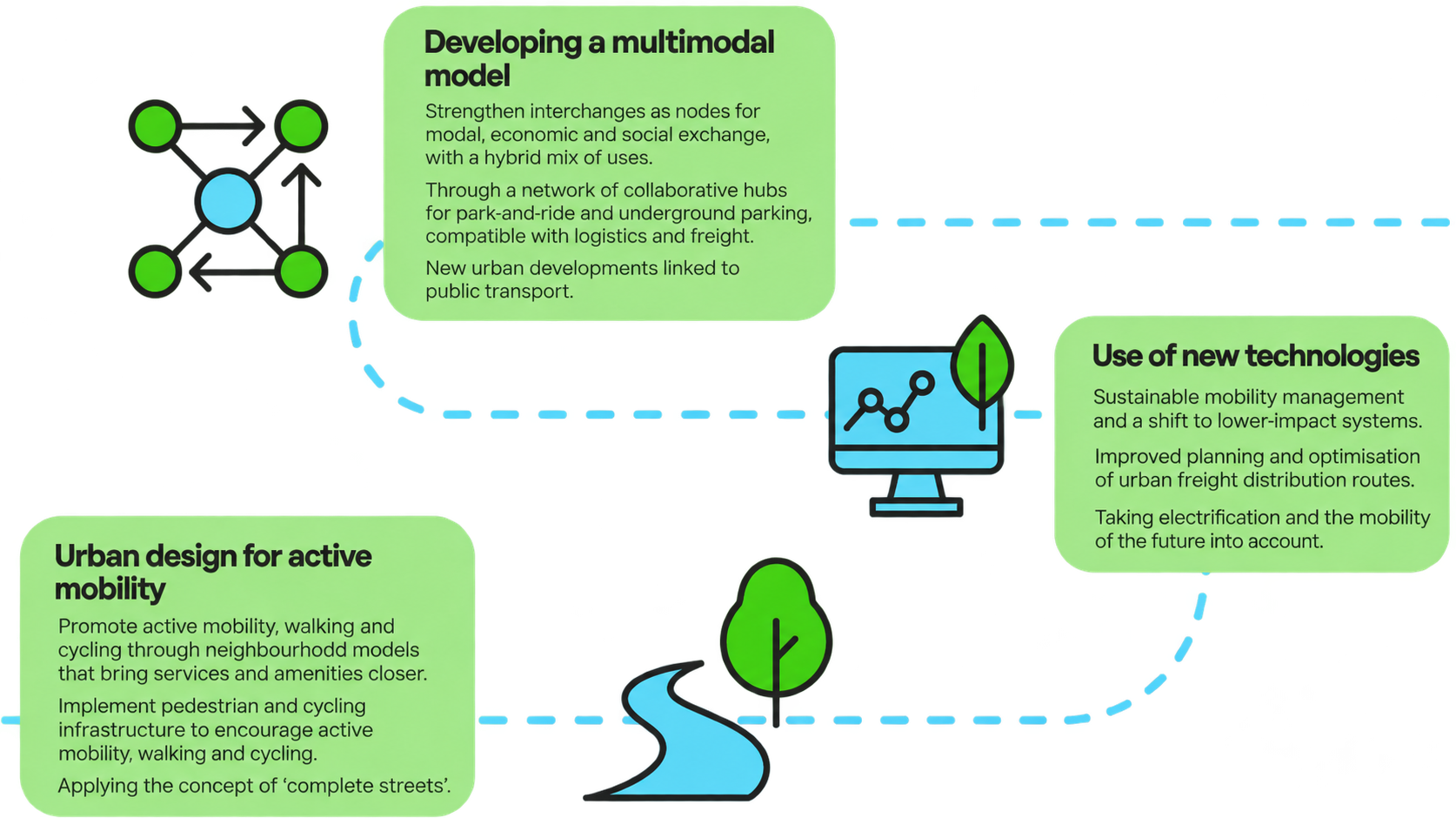
The one focused on the metropolitan area advocates for a dense, polycentric, and connected city, where proximity and universal accessibility are fundamental pillars. At the municipal scale, the city model focuses on creating complete, green, and multifunctional streets that integrate different uses and encourage coexistence between pedestrians, cyclists, and public transport. At the neighbourhood scale, the urban model is centred on proximity and accessibility, ensuring that essential services are close by and that journeys are comfortable and safe.
Academia and universities
0
Public administration
0
Professional associations
0
Companies
0
Independent experts
0
Third sector
0
Working groups
Metropolitan area
Municipal
Neighbourhood
Ideas discussed
This working group brought together representatives from institutional, technical, academic, and private-sector backgrounds. Their reflections highlighted that urban mobility requires a comprehensive vision of the territory, one that considers both the local and regional scales.
Within this approach, neighbourhood mobility emerges as a key element for strengthening neighbourhood self-sufficiency and identifying gaps in services. The group argued that solutions should range from the bus stop to the major interchanges, with particular attention to travel efficiency and journey time optimisation.
For this reason, it is essential to design mobility with the user at the centre, supported by information technology, cycling infrastructure, active mobility, and effective coordination between public administrations, especially when carrying out urban works.